How Resilient Flooring London Specialists Choose Materials for Wood Floor Restoration
Resilient flooring and wood: why the two belong together
When you run a wood floor restoration business in a city that sees as much foot traffic as London, you learn pretty quickly that a beautiful hardwood floor needs the right supporting cast. Over the years, I have worked on projects where the clients had spent a fortune on solid oak or reclaimed parquet, only to watch it wear unevenly because the surrounding finishes or the subfloor preparation were wrong. That is where resilient flooring comes into the picture. In London, where space is tight and budgets are high, getting the balance between traditional timber and modern resilient surfaces can make or break a renovation.
I remember a job near Clerkenwell, a loft conversion that had original Victorian floorboards downstairs and a new extension upstairs. The owners wanted the whole ground floor to feel continuous, but the extension had underfloor heating and a concrete slab that simply would not take solid wood. We ended up specifying a Luxury Vinyl Tile that mimicked the same board width and colour as the restored oak. That project taught me something that has stayed with me ever since: resilient flooring London specialists are not just fitting vinyl or linoleum. They are solving problems that solid wood alone cannot handle.
What resilient flooring actually means on site
Resilient flooring is a broad category that covers everything from sheet vinyl to linoleum, cork, rubber, and the newer stone plastic composite (SPC) products. In London, the term often gets used interchangeably with luxury vinyl tile (LVT), but the reality is more nuanced. A good fitter or restoration specialist will treat resilient flooring as a system: the underlay, the adhesive, the acoustic performance, and the surface finish all need to work together, especially when the floor sits over a timber subfloor that has been sanded and repaired.
For instance, when we restore a wood floor in a period building, we often find that the original joists have moved over time, leaving dips or unevenness. A thin vinyl sheet will telegraph every imperfection. That is why products like Amtico or Karndean, which are thicker and have a flexible backing, can be a better choice over an old floorboard base. They absorb minor unevenness without needing a full screed, which saves time and dust. On the other hand, Forbo Marmoleum, a natural linoleum, is stiffer and requires a near-perfect subfloor. I have seen contractors lay Marmoleum over restored boards only to have the seams show within a year because the timber continued to expand and contract.
Choosing between luxury vinyl tile and sheet vinyl
One of the most common questions I get from clients is whether to go with LVT planks or sheet vinyl. The answer depends on the use case. In a domestic kitchen or a home office, LVT from brands like Karndean or Tarkett gives you the visual warmth of wood or stone without the maintenance. The click-lock systems are easier to replace if a plank gets damaged, and the wear layers on modern LVT are remarkably tough. In a commercial setting, such as a retail shop or a restaurant, sheet vinyl from Gerflor or Altro often performs better because there are fewer joints where water or dirt can get in.
Sheets Amtico, for example, are still a popular choice in high-end residential projects around Chelsea and Kensington. They come in wide rolls, which means fewer seams, and the pattern repeats are long enough that you hardly notice them. But sheet vinyl demands a skilled installer. I have seen too many jobs where the seams opened up because the adhesive was not rolled properly or the temperature was too low during installation. In London, where heating is often turned off in empty properties during winter, that is a real risk.
Linoleum, cork, and bamboo: the natural alternatives
Not every resilient floor is plastic. Natural cork flooring has a loyal following in London, especially for home offices and children's rooms, because it feels warm underfoot and has natural acoustic damping. Cork is also forgiving on timber subfloors because it compresses slightly. The downside is that cork can dent under heavy furniture, and it is not as scratch-resistant as vinyl. If you have a dog that likes to run around, cork might not be your best bet.
Bamboo flooring is another option that sits somewhere between wood and resilient flooring. It is harder than most hardwoods and is technically a grass, but it behaves like timber when it comes to moisture. In London's humid summers and dry winters, bamboo can cup or gap just like oak. For that reason, I usually recommend it only in climate-controlled interiors or as a floating floor with an expansion gap.
Linoleum, often sold under the Forbo Marmoleum brand, is making a comeback in eco-conscious projects. It is made from linseed oil, cork dust, and wood flour, and it is fully biodegradable. The colour goes all the way through the material, so scratches are less visible. But linoleum needs to be sealed properly, and it can yellow in direct sunlight. I have specified it in a few London Design Festival show flats where the aesthetic was deliberately retro, but I would not use it in a south-facing conservatory.
Stone plastic composite and VCT: the commercial workhorses
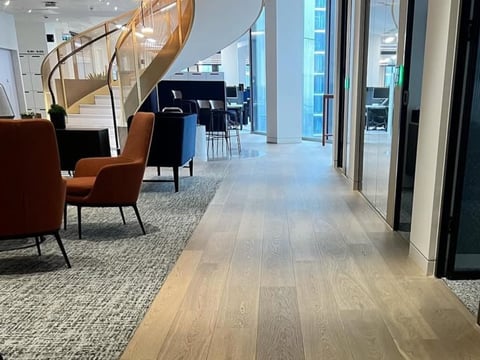
In the commercial sector, stone plastic composite (SPC) flooring has become a major player. SPC is a rigid core board made from limestone powder and PVC, topped with a wear layer. It is dimensionally stable, which means it does not expand and contract as much as LVT or wood. That makes it ideal for large open-plan offices where you want a seamless look without expansion gaps every few metres. I have seen SPC specified in a recent RIBA award-winning office refurbishment near the South Bank, where the design team wanted a timber look that could handle wheeled chairs and heavy footfall.
Vinyl composition tile (VCT) is the old workhorse of London schools and hospitals. It is cheap, durable, and easy to replace in sections. But VCT requires regular waxing to maintain its appearance, and in a high-end retail environment, it looks dated. Polyflor and Altro produce VCT alternatives that are more slip-resistant and have better colour retention, but the maintenance trade-off remains.
Resilient flooring London: practical tips from the workshop
If you are a property manager or a homeowner planning a renovation that involves both restored wood and resilient flooring, here are a few things I have learned the hard way:
- Always let the wood acclimatise before the resilient floor goes down. If you lay LVT over freshly sanded boards that are still releasing moisture, you will get bubbles or adhesive failure within months.
- Use a flexible levelling compound over timber subfloors. Cement-based compounds can crack when the boards move. A polymer-modified compound works better with Crittall flooring installations where the metal frames also expand.
- Check the acoustic rating. In London conversions, building control often requires a minimum impact sound transmission value. Cork underlay beneath LVT can help meet that without adding height.
- Do not mix expansion gaps. Wood needs a 10-15mm gap around the perimeter; many LVTs need only 5mm. If you run the two together without a transition strip, the wood can push the LVT out of alignment.
- Test the cleaning products. Some resilient floor finishes react badly with the oils used on wood. I once saw a mop that had been used with a wood cleaner leave a permanent haze on a Gerflor sheet vinyl floor.
These are the kinds of details that separate a good floor from a floor that needs redoing in two years. And in London, where labour rates are high and down time is expensive, getting it right the first time matters.
How the London Design Festival and RIBA influence material choice
London has a design culture that pushes boundaries. Every September, the London Design Festival showcases new materials and applications. I have seen Tarkett launch LVT collections that are inspired by heritage parquet patterns, and Karndean bring out textures that replicate hand-scraped wood. For a restoration specialist, these events are useful because they show what is possible when resilient flooring is treated as a design element rather than a cheap alternative.
RIBA architects often specify resilient flooring for its sustainability credentials. Some LVTs are now fully recyclable, and brands like Gerflor and Polyflor have take-back schemes. In a city where the Mayor's office encourages circular economy principles, that can be a deciding factor for a commercial tender.
The bottom line on resilient flooring London projects
After nearly two decades restoring wood floors in this city, I have come to see resilient flooring as a partner to timber, not a rival. A well-chosen resilient floor protects the restored wood by reducing wear in high-traffic zones, and it allows the timber to be used where it looks best rather than where it is most practical. Whether you choose Amtico for a Georgian townhouse, Forbo Marmoleum for a eco-renovation, or SPC for a busy office, the key is to understand the subfloor, the environment, and the maintenance commitment.
Resilient flooring London specialists have access to a huge range of products, but the best results come from matching the material to the building's behaviour, not just the colour chart. That is the kind of judgment that only experience brings, and it is why I still enjoy every new project.